
Who got hit hardest by the 2025 UN staff cuts?
Updated: Aug 12
August 2026 (Updated on 12 Aug. 2026)
By Katja Hemmerich

The UN Chief Executives Board (CEB) has started to release some of its personnel data about the number of staff in the UN system in 2025, in preparation for the next High Level Committee on Management (HLCM) meeting in late September. The data finally allows for a preliminary analysis of which staff were hit the hardest by last year’s budget cuts.
While the financial data for 2025 is not yet available from the CEB, the OECD has already indicated that 2025 saw a historic decline of overseas development assistance (ODA), which appears to have hit the UN particularly hard, with a 27% decline in core voluntary contributions already recorded for 2025. But did this translate to commensurate declines in staffing across the UN system or were some parts of the UN hit harder than others? Staff unions also raised concerns in various fora that senior level positions were disproportionately protected at the expense of junior level staff, reinforcing more general concerns voiced by some member states and stakeholders that the UN is too 'top heavy'.
This month’s spotlight unpacks these questions — and confirms that, as is so often the case, there is no ‘One UN’. Some entities endured deep cuts; a surprising number of others actually increased their staff. In some entities, the numbers suggest intentional, equitable workforce planning. Elsewhere, the shifts raise more questions than answers.
Which UN entities suffered the largest staff cuts?
IOM and UNHCR were by far the hardest hit, both in terms of absolute numbers of staff cuts and the proportional decline of their workforce. The number of staff in IOM fell by 4,471 people from 2024 to 2025, reflecting a 29.5% decline. UNHCR is the only other UN entity to have decreased its staff by more than 20%, losing 2,932 staff, equivalent to a 22% decline, according to CEB data. UNAIDs and UNICEF were the other two UN entities that cut more than 10% of their workforce. The significantly smaller size of UNAIDS means its 19% decline translated into 118 staff, whereas UNICEF’s 10.5% decline comprised 1,614 staff.
With all the often contentious negotiations about cutting budgets and posts in the UN Secretariat and WHO last year, it is perhaps surprising that they only saw a 6% and 5% reduction in their staffing respectively in 2025. While UNHCR and IOM are funded through voluntary funding, which disappears (and in other times appears) much more quickly, both the Secretariat and WHO are funded through a combination of assessed and voluntary funding, meaning more reductions will happen in 2026 which is not yet evident in the CEB's figures. The WHO restructuring which had a clear timeline from January 2025 to 30 June 2026 anticipates an overall staff reduction of 23% (or 19% if prioritized vacant posts are filled) due to restructuring, according to its annual report on human resources presented to the World Health Assembly (A79/21 Add.1). Consequently, this year's CEB figures only reflect an interim stage of WHO's restructuring and next year's CEB figures will likely reflect a much larger reduction in staff numbers. The Secretariat will also likely see greater reductions in 2026, although it remains to be seen by how much as the 2025 staff reductions appear to reflect efforts to anticipate 2026 reductions in 'regular budget' positions, in addition to reductions resulting from a loss of voluntary funding.
What is perhaps more surprising, is that despite all the negative financial development, UNDP actually grew by 5.6%, adding 411 staff between 2024 and 2025. In fact, 20 of the 39 entities sharing data with the CEB saw an increase in their staff in 2025.
Like UNDP, several of these are entities that are being proposed to be merged, to create efficiencies. UNSSC grew by a surprising 19% increase (11 staff) and UNITAR by 9% (7 staff). By contrast, UNWomen and UNFPA, which are also being proposed for a merger, remained close to the status quo. They both saw a 1% decrease in staff, as if their respective management is waiting to redesign its workforce based on whatever decision is taken by member states on the merger.
It’s possible that the modest increase in staff numbers in UNSSC and UNITAR reflects managers filling vacant posts to put themselves in a stronger position to navigate the restructuring that will inevitably following a merger. A similar pattern can be observed prior to the restructuring of both DMSPC and DOS, and DPO and DPPA, which all saw modest increases in their staffing number in 2017 and 2018 as member states discussed the proposed changes to those departments.
Or, the UNSSC and UNITAR increases may be part of a broader trend of all the training and research institutes growing in 2025 for some reason. The UN University growing by 13% (20 staff) and the ILO’s Training Center in Turin also adding 6 new staff in 2025, amounting to a 3% increase.
Which staff categories were hardest hit?
Of all the staff categories, the General Services staff were the hardest hit by the budget cuts. In terms of absolute numbers, they saw the greatest decline in staff (7,500) across the UN entities reporting to the CEB - more than International Professional, National Professional, and Field Service losses combined (3,270). This was driven primarily by the cuts in IOM and UNHCR, where GS staff faced the largest proportional decline by category, as well as sizable reductions in in UNICEF, WFP and the UN Secretariat. The graph below shows the % change in each of those organizations by category.

It’s striking that the UN Secretariat, which generally has disproportionately fewer National Professional Officer positions than field-based UN agencies, funds and programmes actually saw a net increase of NPOs in 2025.This may be a reflection that parts of the Secretariat, like several UN agencies, funds and programmes made an effort to use National Professional Officers to to take on some of the work previously done by junior level international professionals. From the raw data which does not include information on functions, it’s hard to tell if there really was a substitution effect, but it is noteworthy that IOM, UNHCR and UNICEF cut their National Professional Officers at a lower rate than junior level international professionals (P-1 to P-3). WFP, whose staff declined by 7% overall, spread that out amongst General Service and International Professional staff equally, while cutting less than 1% of their National Professional Officers.
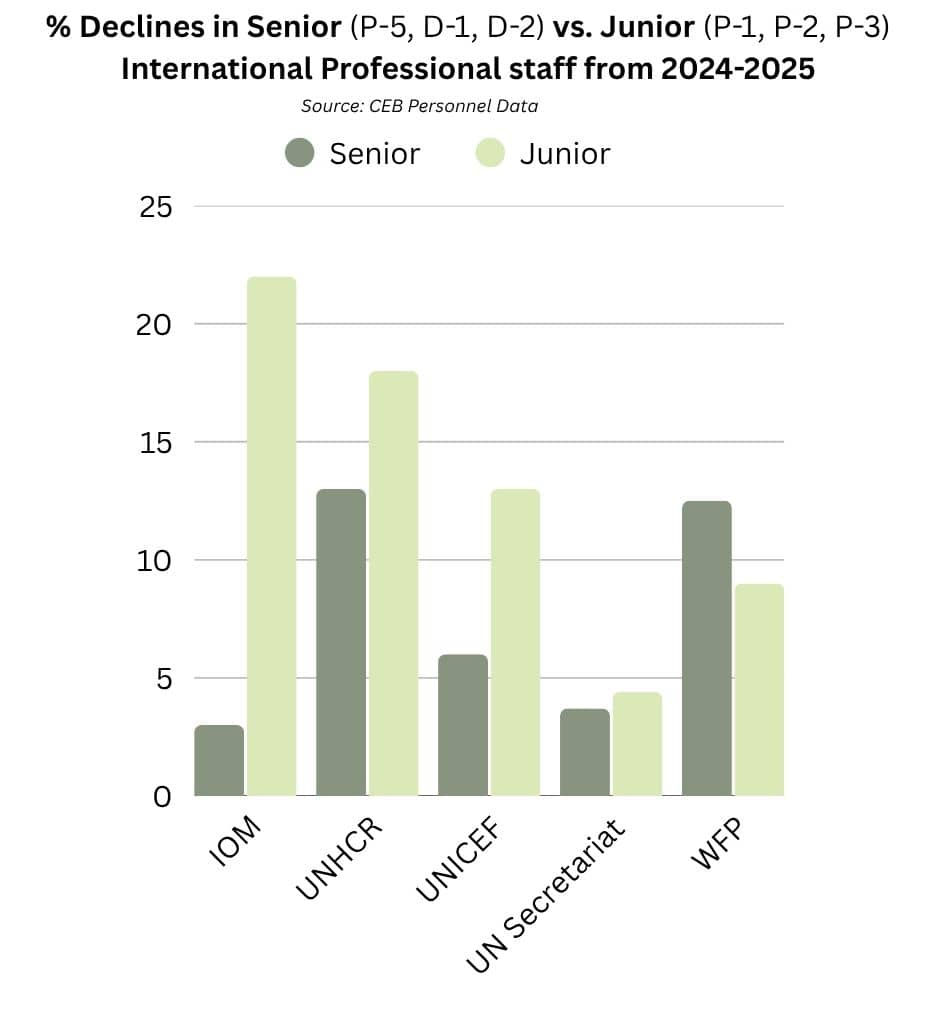
How did junior levels fare compared to senior staff?
Considerable concerns were raised by staff unions during WHO’s restructuring exercise last year that senior level staff were being protected from the budget cuts. Maybe they were wrong, or maybe those complaints had the desired effect. P-5, D-1 and D-2 staff in WHO declined collectively by 8% in 2025 as compared to a 3.7% decline for P-1-P-3 levels. The only level which saw an increase in staff in 2025 in WHO were P-2s, albeit only an increase of 2 persons.
In addition to WHO, WFP’s cuts in 2025 also hit senior levels harder than junior levels, but as highlighted in the graph, these organizations were the exception rather than the rule. The 12.5% decline of senior level positions in WFP was driven primarily by a reduction of 61 P-5s, the largest % decline of any international professional level, followed closely by D-2s. By contrast, IOM, the small decrease in P-5 to D-2 positions is in large part due to the fact that they actually increased their overall number of D-1 staff from 2024 to 2025 by a shocking 19% (12 additional people).
UN Workforce impacts
There have been growing criticisms in recent years that the UN is ‘top heavy’, which supposedly has also contributed to a lack of trust in the UN and funding declines. While the causality of this argument is somewhat oversimplified, the personnel data does indicate that the UN workforce is not a pyramid. Ironically, the staff reductions in 2025 appear to have made that problem worse.
IIn the big UN entities, like the Secretariat and UN agencies, funds and programmes, P-1s are a rarely used level and P-2s, considered to be the entry level, never outnumber the next level up (P-3). When I was designing the mobility policy for the UN Secretariat almost 15 years ago, it was noticeable that in many functional areas there were often the same or sometimes even more P-4s than P-3s, who themselves vastly outnumbered P-2s. The CEB data from 2018 indicates that the Secretariat was starting to shift that dynamic with P-3s as the fastest growing level of international professionals - until 2025, when P-3s saw the highest proportional reduction in staff.
While Kofi Annan was initially recruited as a P-1, there may be a legitimate argument that the P-1 level staff is no longer useful to attract the right staff and one that HR practitioners may want to research and confirm with data and evidence. But P-2s do seem to be relatively widely used across the system albeit with significant variations. The ICC is the only organization that actually had a workforce pyramid from P-2 upward in 2025. IOM has also been better at using P-2s than other large UN entities so that even with junior level staff being disproportionately hit by the cuts, P-2s still outnumbered P-5s in 2025. WHO which added P-2s in 2025 still has P-5s outnumbering P-2s, as does WFP despite its heavy cuts to the P-5 level. The graph below demonstrates how different the international professional workforce was in UN entities in 2025. IOM’s structure is closer to that of ICC, with the UN Secretariat, WFP and UNHCR in between IOM and WHO's egg shaped workforce.

Given the criticisms and how the staff cuts have played out so far, these are some important issues that the High Level Committee on Management (HLCM) may want to discuss at the end of September when they are presented with the personnel statistics. The financial crisis has forced workforce restructuring, and maybe this is finally the time for management to determine why P-2s (and P-1s) are so underutilized in larger UN entities, but seem to be a useful part of the workforces in the ICJ, UN Tourism, the International Criminal Court (ICC), UNITAR, UNSSC and UNU.
On a final note, not all the workforce impacts are negative. In a world where the goal of gender parity is increasingly being called into question, the UN has continued to stay true to its values. Despite all the cuts, the overall UN workforce has actually moved closer to gender parity in 2025, and it is now 1.7% away from that target as compared to 2.3% in 2024. Most entities saw relatively equal or comparable declines in their male and female staff. WFP and the UN Secretariat are two entities, which still had some way to go in achieving gender parity, and appear to have guided the staff reductions so that women were less impacted than men. In the UN Secretariat, women were 59% less likely to be impacted by staff reductions than men in 2025, and in WFP women were 50% less likely to be impacted.
These positive gender impacts highlight how the current budget crunch can also be an opportunity to address some of the workforce challenges that have faced the UN. But that's only possible if leadership takes a strategic approach to how it downsizes and restructures its workforce - which has clearly happened inconsistently across the system, as this spotlight article has demonstrated. It’s unfortunate that the personnel data that the CEB publishes comes out so late in the year, making it hard for organizations to learn and course correct, or reinforce the positive consequences, because they have already put together most of their plans for 2026. There is clearly a lot more to unpack as further data gets published by the CEB. Nevertheless, we hope this preliminary analysis provides some food for thought for the HLCM, managers and HR professionals across the UN system.


